


An attacker using AI assistants stole a database containing more than 5,200 records from an Indian public university, according to an October 21 investigation by Unit 42. The operator, known as BUGSTER, also explored telephone fraud and other schemes. The important distinction is in the evidence: researchers confirmed the university data theft, while the telephone operation appeared to be planning or early setup.[1]
A login result was only the beginning of the story
Unit 42 examined the operator’s working environment rather than relying only on a victim’s alert. It found reconnaissance reports, scripts, conversations and files recording the results. That visibility makes it possible to separate what an assistant suggested from what the attacker actually accomplished.
At one university, the attacker used AI-generated reconnaissance to map the online education platform and identify user accounts. Public author information supplied names even where a direct account-listing route was blocked. Those names then fed a password-guessing tool, which reported a candidate login. A tool reporting a usable credential is a narrower finding than proof that the attacker downloaded a database from that site.
The confirmed theft concerned a second university. There, the attacker obtained an administrator account protected by a weak password and extracted a MongoDB database. A manifest recorded the dumped collections; the data included student and faculty personal information. The report also described exposed infrastructure and a third-party storage service account. It does not establish that every exposed service was subsequently abused.
One operator, several assistants
The working environment combined Hermes Agent with DeepSeek V4 and Cursor for coding assistance. Unit 42 found configurations intended to bypass safeguards. Different assistant profiles handled general requests, telephone-fraud advice and carrier research, with Telegram providing an operator interface.
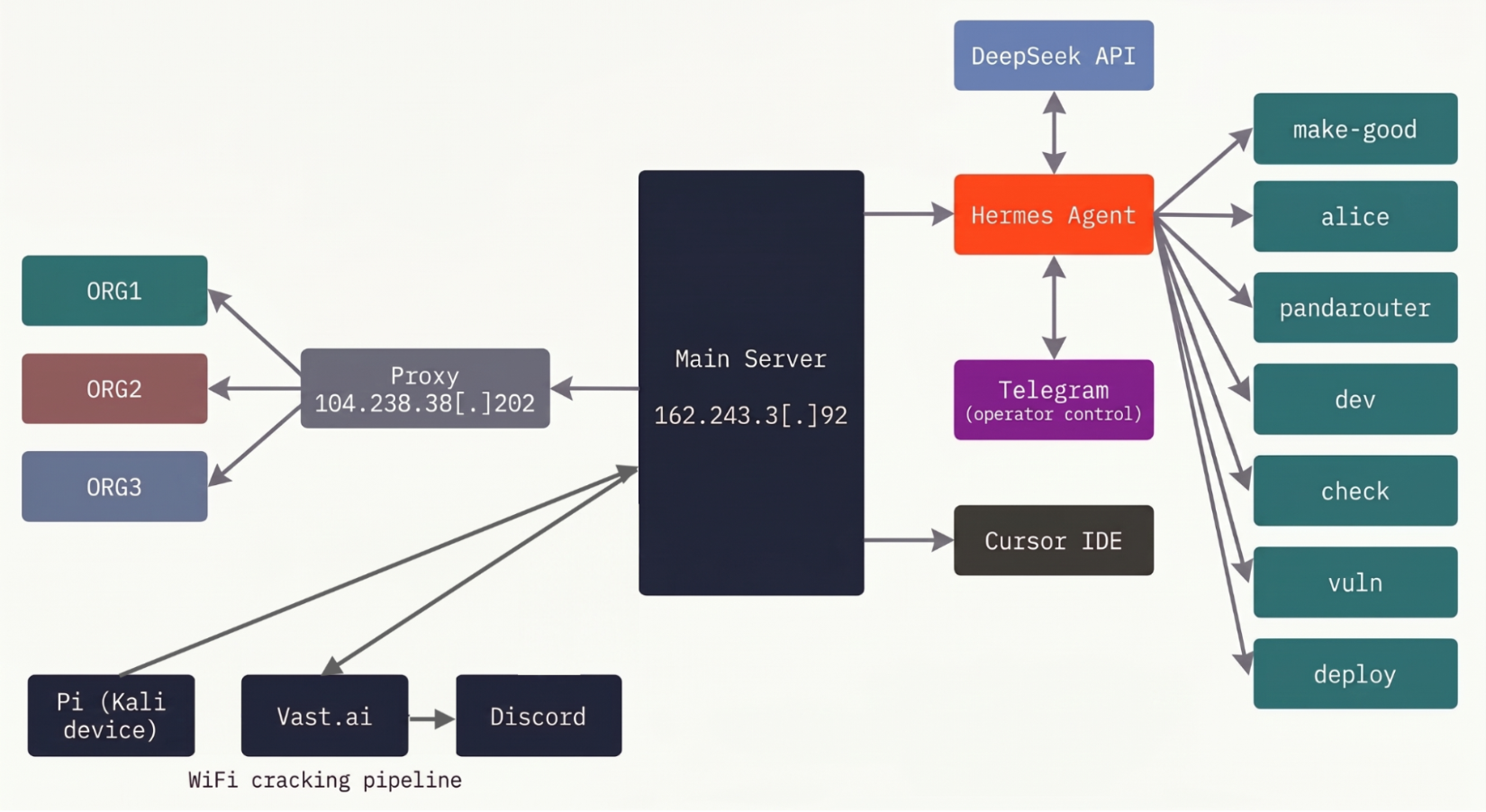
The diagram helps explain the division of labor. AI could organize reconnaissance, write scripts and advise on another criminal business while the operator reused a shared server. It did not make weak passwords or existing access requirements disappear. Nor does a profile name prove that the corresponding task ran: researchers found additional development and testing profiles without observing their chat artifacts.
This is a separate case from the Cairn investigation involving exposed control panels. Similar AI tools do not establish the same attacker or the same infection chain.
The fraud plan was not a completed fraud operation
Telephone-fraud conversations and carrier research showed preparation, but Unit 42 found no call logs, signaling traces or active routing to demonstrate an operating call-fraud service. Cryptocurrency reconnaissance likewise identified potential future targets without observed follow-on activity. Neither finding supports a claim of proven telephone losses or stolen cryptocurrency.
The distinction matters when reading AI attack reports: a generated proposal, a script on disk, a tool’s success message and confirmed stolen records carry different weight. In this case, the university database is the concrete harm; the wider plans show the operator’s ambitions.
What the evidence changes for defenders
Administrators should review weak or reused privileged credentials, database exposure and access to storage accounts, then correlate authentication with database exports and unusual outbound transfers. Preserve logs before changing confirmed compromised credentials and removing unauthorized access. A student should rely on the university’s incident notice for affected-record details; this report alone does not identify every person whose information was taken.
The lesson is specific: a poorly skilled operator can use assistance to turn ordinary access failures into real data loss. The response still depends on finding the access path and checking what left the system, rather than treating every AI-generated plan as an accomplished attack.
References
- Unit 42. “Next Exploit Opportunities”: How a Threat Actor Used AI to Help Plan and Execute Multiple Types of Cybercrime Activities. Palo Alto Networks, October 21, 2026; accessed October 22, 2026. Investigation and evidence.