OpenAI has banned a cluster of ChatGPT accounts that it assesses were very likely operated from Russia and used to promote a covert influence campaign built around the International Burke Institute (IBI). The supposed Israel-based expert community displayed copied research, questionable author attributions, and a proprietary “sovereignty” index that consistently favored Russia. ChatGPT was mainly used to create promotional posts and comments for social platforms—not the articles and country reports published on the IBI website.[1]
The disclosed evidence supports calling the operators Russia-based or Russia-linked. It does not, on its own, establish that the Russian government directed the campaign. OpenAI said the accounts prompted the model in Russian, asked it to remove linguistic clues that could reveal their origin, and used VPNs to access the service because OpenAI does not provide access to its models from Russia.
What OpenAI found
The operation used ChatGPT to draft mostly English-language posts and replies promoting IBI content on X, LinkedIn, Facebook, Substack, and Telegram. Some posts came from accounts bearing the institute’s name and logo. Others appeared to come from ordinary users whose activity largely consisted of sharing IBI material.
One operator also generated German-language posts for a Telegram channel that criticized Ukraine, the European Union, and the German government while advocating closer relations with Russia. Another generated logos for a group of channels targeting audiences in Germany, the United States, France, Poland, and Türkiye, then repeatedly requested Russian-language summaries of their activity.
That activity gave OpenAI a route into the broader operation. The company banned the associated ChatGPT accounts, but it did not claim that every article, report, or account connected to IBI was AI-generated.
A fake layer of academic credibility
The International Burke Institute presented itself as an “expert community” based at an address in Israel. Its website, registered in February 2025, displayed prominent academics and public figures and published research under their names.
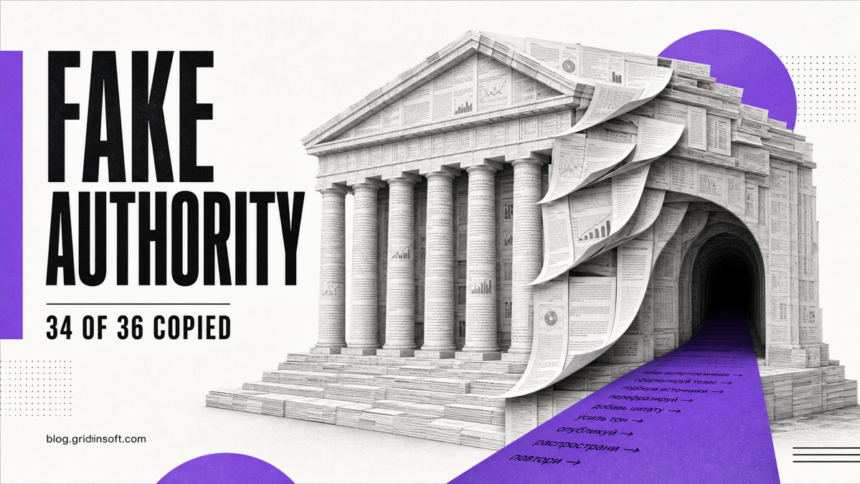
OpenAI reviewed 36 articles linked to purported IBI experts and published between September 2025 and May 2026. It found that 34 had been copied from elsewhere on the web. Some were years old, while others were assigned to the wrong author. In one case, an article originally published by Cambridge University Press was attributed to a different professor. Another migration-policy article was associated with an Australian food chemistry professor.
The site also contained language errors consistent with machine translation from a Slavic language. One article referred to Germany’s traffic-light coalition as the “Svetofor coalition,” using a transliteration of the Slavic word for traffic light rather than the established English or German expression. A translation artifact is not proof of origin by itself, but in this investigation it was one signal among account activity, prompts, access patterns, copied material, and coordinated promotion.

The “sovereignty index” supplied the narrative
IBI promoted a proprietary sovereignty index and country reports that praised Russia while portraying France, Germany, the European Union, and the United States as politically or economically dependent. OpenAI said these reports were not generated with its models.
This distinction matters. AI did not need to manufacture the entire institution. Its role was narrower and operationally useful: creating multilingual posts and comments that pushed readers toward a website designed to look like an independent source of expertise. The copied academic work, expert profiles, institutional address, and index supplied the appearance of authority.
The campaign built more infrastructure than influence
OpenAI assessed the immediate impact as limited. Typical posts received few views, and official IBI accounts had small audiences. The related Telegram channels were larger, generally showing between 10,000 and 20,000 subscribers, but the company placed the operation only at the lower end of Category Three on the Brookings Breakout Scale: activity across multiple platforms with some signs of reaching authentic audiences.
The more important risk was the infrastructure. A polished institution containing purported experts, reused academic material, and a proprietary index could be expanded over time or cited by people who never check its origins. Independent reporting also found a more complicated footprint involving individuals in Israel, while noting that the relationship between those people and the Russia-based operators remains unresolved.[2]
How to check an unfamiliar think tank or expert source
Use the same pause-and-verify habit that applies to other suspicious websites and online claims, but focus here on authorship, methodology, and institutional transparency rather than treating one technical score as a verdict.
- Verify the named experts independently. Check an expert’s university, employer, personal page, and publication history rather than relying on the institute’s biography.
- Search article titles and distinctive passages. An exact-title or quoted-sentence search can reveal an older original, a different author, or wholesale copying.
- Inspect the methodology. A serious index should explain its data sources, weighting, limitations, uncertainty, and update process. A numerical ranking without reproducible methods is a claim, not proof.
- Look for transparent ownership and funding. A street address and professional design do not establish who controls an organization or pays for its research.
- Check the domain’s history and reputation. A recently registered domain or abrupt change in purpose deserves additional scrutiny. A domain reputation check can identify technical risk signals, but it cannot prove that an article is accurate or politically neutral.
- Confirm important claims elsewhere. Look for primary documents and independent institutions that disclose their own methods and evidence. The UK House of Commons Library recommends examining a source’s aims, expertise, evidence, funding, methodology, and treatment of uncertainty.[3]
One grammatical error, unfamiliar organization, or controversial conclusion does not prove an influence operation. The warning becomes stronger when multiple signals converge: unverifiable experts, copied work, hidden ownership, opaque rankings, coordinated promotion, and repeated attempts to disguise the source.
References
- OpenAI. “Disrupting a new covert influence campaign from Russia.” OpenAI, August 25, 2026; accessed August 27, 2026. OpenAI investigation.
- Le Monde. “Russian disinformation on ChatGPT: Fake Telegram channels, fake videos and a real-fake Israeli think tank.” Le Monde, August 25, 2026; accessed August 27, 2026. Independent investigation.
- House of Commons Library. “How to evaluate sources.” UK Parliament, 2026; accessed August 27, 2026. Source-evaluation guidance.